
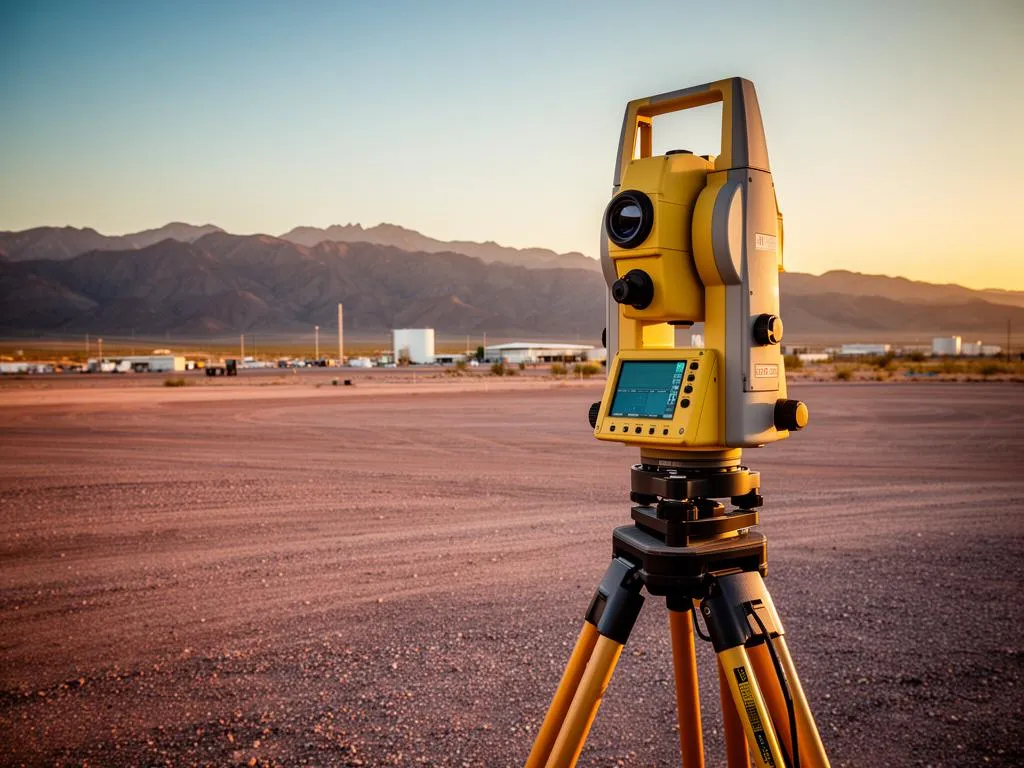
Laser scanning in extreme heat is a normal part of summer work in the Valley, not an exception. Air temperature, sun on the instrument, hot pavement and monsoon dust all change what a 3D scan can deliver and when it can be done. This guide puts the manufacturers' published operating limits next to National Weather Service climate data for Phoenix and turns them into a plan. If you are booking 3D laser scanning in Phoenix between May and October, it tells you what to ask for.
In short: several common scanners are rated to 40 °C (104°F); the Phoenix July normal high is 106.5°F, and asphalt in an Arizona study reached 152°F at midday. So scan exteriors, roofs and parking lots from first light into the morning, keep long outdoor shots short and steep to limit heat shimmer, move indoors at midday, keep batteries and laptops cool, and keep monsoon afternoons flexible.
How extreme heat affects laser scanning
Heat touches a scan in four separate ways. Each needs its own fix, so it helps to keep them apart.
- The instrument's rated range. Every scanner has a published operating temperature. Above it, the maker no longer guarantees the spec, and some units stop or warn.
- The air between scanner and surface. Hot air over pavement and roofs bends the beam, which adds noise to long, low shots.
- The setup itself. Sun on one side of a tripod or scanner makes parts expand unevenly and can tilt a long scan.
- Everything around it. Batteries, field tablets and laptops have their own, often lower, limits. So do people.
3D scanner operating temperature: published limits
Here are the operating ranges published by three major manufacturers for current terrestrial scanners. They are the makers' own figures, listed to show the range of limits, not the equipment of any particular firm.
| Scanner | Operating temperature | In °F | Dust and water rating |
|---|---|---|---|
| Leica RTC360 | -5 to +40 °C | 23 to 104°F | IP54 |
| Leica BLK360 | 0 to +40 °C | 32 to 104°F | IP54 |
| Leica ScanStation P30 / P40 / P50 | -20 to +50 °C | -4 to 122°F | IP54 |
| FARO Focus i.1 | -10 to +40 °C; extended -10 to +55 °C with the Thermal Cover accessory | 14 to 104°F; extended to 131°F | IP54 |
| Trimble X9 | -20 to +50 °C | -4 to 122°F | IP55 |
Sources: Leica TLS comparison chart, 2025; FARO Focus i.1 technical specification; Trimble X9 product page. Fahrenheit conversions are ours.
Two details in the FARO sheet matter for Phoenix. Its high-temperature mode needs an extra accessory, and FARO recommends running the on-site compensation routine when the unit has been exposed to exceptional temperature. FARO also lists a storage range of -10 to +60 °C (14 to 140°F), which a closed car in the sun can exceed.
How hot a Phoenix summer really gets
Air temperature figures below are official National Weather Service data for Phoenix Sky Harbor.
- July normal high: 106.5°F (about 41 °C), July normal low: 84.5°F (about 29 °C), 1991-2020 normals (NWS Phoenix, July 2025 summary).
- July 2025 averaged a 107.6°F high and set a record high of 118°F on July 9; record warm lows of 93 to 95°F were set on July 1, 9 and 10.
- In 2024, the warmest year on record for Phoenix, Sky Harbor logged 70 days at or above 110°F, 143 days at or above 100°F, and 39 days when the low never fell below 90°F (NWS Phoenix 2024 review).
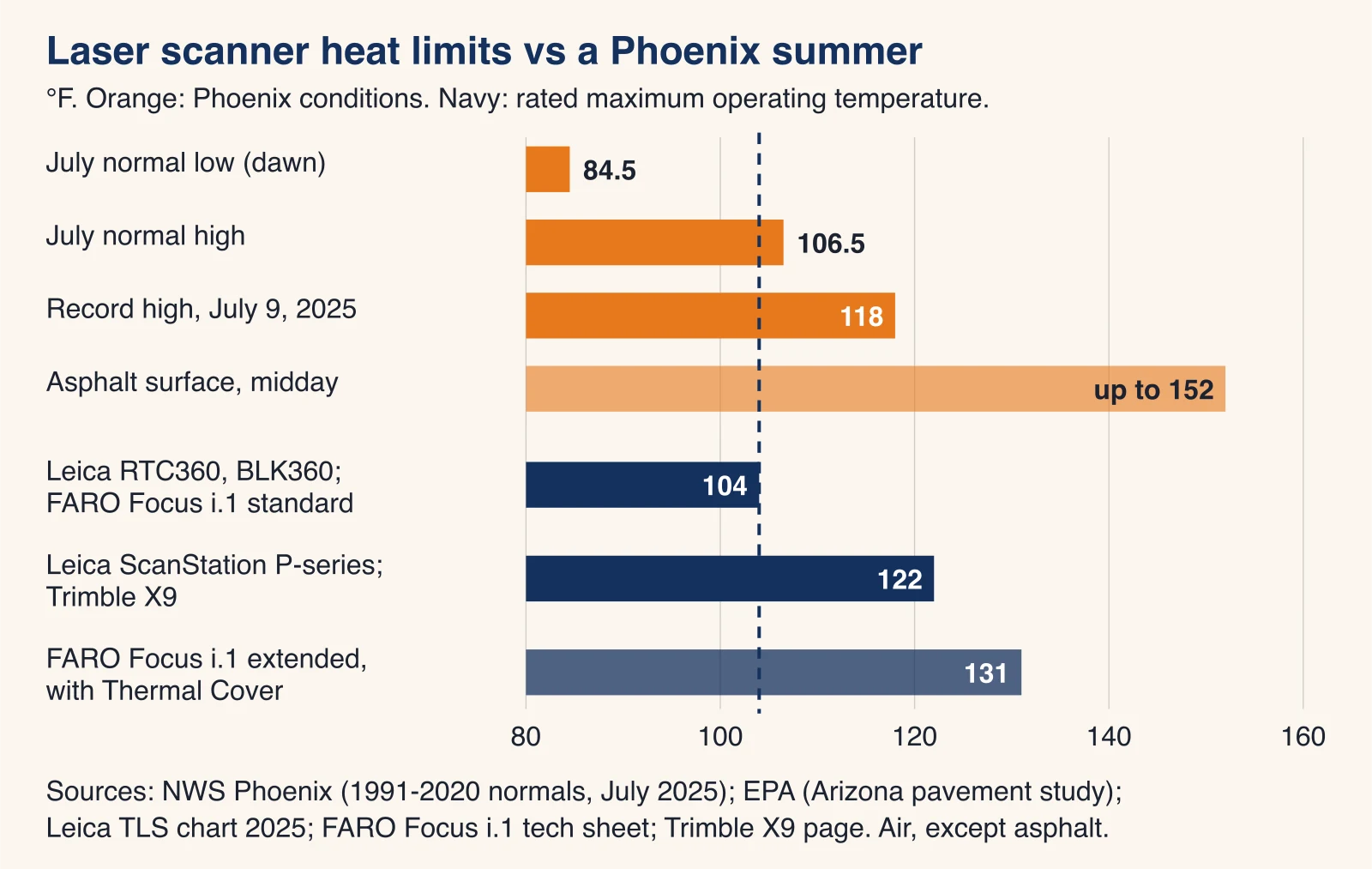
The pattern is plain. A normal July afternoon already sits above the 104°F limit of several compact scanners. A record day like July 9, 2025 (118°F) comes within 4°F of the 122°F limit of the long-range scanners. A normal July dawn, at about 84.5°F, sits comfortably inside every range in the table. And those are shade temperatures: a scanner in direct sun on a dark roof runs hotter than the air.
Heat shimmer and refraction on long outdoor shots
The shimmer you see over a parking lot in the afternoon is the same thing a scanner's beam travels through. Air heated by the ground is less dense than the air above it, and that creates a gradient in the air's refractive index that bends light, the effect known as heat haze. The bending shifts from moment to moment as the hot air rises.
For a laser scan, that means noisier points and slightly wavering surfaces on shots that skim low over hot ground for a long distance. Short, steep shots are barely affected; a long, grazing shot across a hot lot is affected most. The hot surfaces in Phoenix are serious: the EPA reports that in a pilot study in Arizona, conventional asphalt reached surface temperatures up to 152°F at midday (EPA, cool pavements).
What helps:
- Scan exteriors early, before pavement and roofs heat up.
- Shorten the shots. Add positions so facades and site features are captured from closer range.
- Raise the angle. A tall tripod or a position on a curb, dock or roof edge reduces the length of beam that skims hot ground.
- Check the overlap. Registration residuals that grow on exterior positions taken late in the morning are a clue that shimmer or drift crept in.
Heat also works on the setup. Strong sun on one side of a tripod makes that side expand and can slowly tilt the scan, as the Wikipedia overview of 3D scanning notes. A shade umbrella over the scanner and tripod, and a short wait after moving from an air-conditioned interior to the outside, keep the instrument stable.
Scanning roofs and parking lots in a Phoenix summer
Roofs and paved sites combine every heat problem: no shade, reflected sun, hot surfaces and long sightlines.
Roofs
- Book the roof first thing. Rooftop units, ducts, curbs and parapets are dense with detail and need many close positions. That takes time, and time on a roof in July should be in the morning.
- Plan access. Roof hatch, ladder or lift, tie-off points, and whether the building engineer must be present. Access delays push the work into the heat.
- Watch reflective coatings. White and foil-faced roof membranes and bright metal return strong, sometimes noisy, signals. Scanning from a slight angle rather than straight down at glossy surfaces helps.
- Keep crew safety first. Water, shade breaks and two people on the roof are basic summer practice.
Parking lots and site work
- Expect the longest shots of the job, and so the most shimmer. Add positions rather than reaching across the lot.
- Traffic and parked cars hide the surface. Early morning gives both cooler air and emptier lots.
- For large sites, aerial or drone capture may be faster than tripods. Our comparison of LiDAR vs 3D laser scanning explains when each fits.
Monsoon season: dust, wind and storms
The National Weather Service counts the North American Monsoon from June 15 to September 30. During the 2025 season, on August 25, a dust storm traveled from the Tucson area up through Phoenix and into southern Yavapai County with near-zero visibility in many areas (NWS 2025 monsoon review).
For scanning, monsoon days bring:
- Dust in the air, which scatters the beam and shows up as floating noise in the point cloud, and dust on the optics.
- Wind that shakes tripods and grounds drones.
- Lightning and sudden rain. Most scanners in the table are rated IP54: in the IP code, 5 means dust protected (some dust can enter, not enough to stop it working) and 4 means protected against splashing water. The Trimble X9's IP55 adds protection against water jets. None of that makes it wise to keep scanning in a storm.
Storms often build in the afternoon and evening, which is another reason to front-load exterior work in the morning. Keep a weather day in the schedule for exterior-heavy jobs in July through September, and switch to interior positions when a storm approaches.
Batteries, tablets and laptops in the heat
The scanner is often not the first thing to fail in the heat. Field tablets, phones and laptops used to control the scanner and pre-register scans have lower limits. Apple, for example, says to use its Mac laptops where the ambient temperature is between 50 and 95°F and warns that parked cars get hotter than that (Apple Support). A Phoenix summer morning can pass 95°F before work is done.
- Keep spares cool. Batteries and devices go in a cooled cab or an insulated bag, never on a dashboard or in a closed trunk.
- Swap in the shade. FARO lists about 4 hours of typical battery operation for the Focus i.1; plan swaps at shaded points in the route.
- Back up often. Copy data off the field device at every break, so a heat shutdown never costs a morning of scans.
Scheduling a summer scan: an illustrative plan
Worked example (illustrative): a single-story retail building in Phoenix in July, with a roof full of rooftop units, a parking lot to capture, and an occupied, air-conditioned interior. Using the NWS normals (low 84.5°F near dawn, high 106.5°F in the afternoon), a sensible plan looks like this:
- First light: roof positions, while the roof and air are at their coolest. Rooftop units and parapets need the most positions, so they go first.
- Early morning: parking lot and facades, with extra positions to keep shots short, before pavement heats and traffic arrives.
- Late morning to afternoon: interior positions in air conditioning, working around business operations.
- Afternoon, if needed: remaining interior rooms. No new exterior work; if storms build, nothing outside at all.
- Next morning, if needed: any exterior gaps found when checking registration overnight.
Ask any provider how they will sequence your site in summer. If the answer is "we'll scan the roof after lunch," keep asking. And if your job is in the cool months, October through April, most of this simply goes away.
For exterior sites, roofs and large outdoor areas, see how LiDAR scanning in Phoenix is planned, and if you are new to the method, start with what 3D laser scanning is. When you have a building and a deadline, send the address, square footage and deliverables for a quote; summer scheduling for 3D laser scanning in Phoenix starts with knowing what has to be captured outdoors.
Frequently asked questions
What is the operating temperature of a 3D laser scanner?
It varies by model. Leica lists -5 to +40 °C for the RTC360 and -20 to +50 °C for the ScanStation P-series; FARO lists -10 to +40 °C for the Focus i.1, extendable to +55 °C with a Thermal Cover accessory; Trimble lists -20 to +50 °C for the X9. Check the spec sheet of the exact scanner on your job.
Can you laser scan outdoors in a Phoenix summer?
Yes, with scheduling. The NWS July normal high at Sky Harbor is 106.5°F, above the 104°F limit of several compact scanners, but the normal low is 84.5°F. Exterior and roof work done from first light into the morning stays inside most published ranges; interiors with air conditioning can be scanned at any hour.
Does heat affect laser scanning accuracy?
It can. Hot air over pavement and roofs bends light and adds noise to long, low shots. Sun on one side of a tripod can make it expand unevenly and tilt the scan slowly. Keeping exterior shots short and steep, shading the setup and working early reduces both effects.
Is it safe to scan a roof in Phoenix in summer?
Roof scans are best done early in the morning, when the roof surface and air are coolest, with water, shade breaks and a second person on the roof. Afternoon roof work in July puts both crew and equipment at risk and produces noisier data.
What happens to laser scanning during monsoon season?
The NWS counts the monsoon from June 15 to September 30. Dust storms, wind, lightning and sudden rain stop exterior scanning. Many scanners are rated IP54, protected against dust and splashing water, not against a downpour. Interior work usually continues.
Do batteries and laptops overheat during field scanning?
They can. Apple, for example, says to use its Mac laptops in ambient temperatures between 50 and 95°F and warns that parked cars get hotter. Keep spare batteries and field laptops in a cooled vehicle or cooler bag, never on a dashboard, and swap batteries in the shade.